Why Passive Optical Network for access networks?
Passive Optical Network (PON) is, not only one access technology used by service providers, but also the technology with a dominant position in the access market. First, let´s have a look at the telecommunication network infrastructure: it is composed mainly by 3 segments: the core/backbone for long-haul communications, the metro/regional where we have the traffic aggregation and the access network[1]. Let´s see what is out there and the main differences:
Access networks can be wireless, copper based or fibre based[2]:
a) the wireless option although it has the lowest deployment cost, it lacks enough bandwidth to support video applications. In these, it is usually used a point-to-multipoint architecture and the bandwidth is shared by multiple users.
b) the copper technology, more specifically the digital subscriber line (DSL) uses the point-to-point architecture. This means that instead of sharing 50 Mbps over all subscribers, DSL can provide the same 50 Mbps to each subscriber. However, it is a noise-limited access technology: the effective bandwidth DSL provided to a subscriber depends on the level of noise and this depends on the length of the copper loop.
c) fibre technology: in this, the access network can be architected using a point-to-point methodology or a point-to-multipoint one. The former has a low market impact mainly due to its cost. On the point-to-multipoint architecture, a single fibre from the Central Office (CO) can serve several subscribers. When using shared fibre architectures, the signals can be broken out using Active Ethernet or using PON. When using PON, not only are there no electronic components in the field, which is cost attractive and might be considered to have more reliability, but also it is simpler to upgrade to higher bit rates.
Note: Check out my previous blog post about optical fibres Are optical fibres all the same? How can the fibres be used for optical fibre sensors to recap the structure of an optical fibre.
What problems can the Passive Optical Network tackle?
Bandwidth is key! There is a new high bandwidth demand for ultra-high definition video, 5G mobile transport, cloud services[3] and IoT applications[4]. This application, for example, allows real-time communications, sensing, monitoring and resource sharing in a huge smart device connectivity with very distinct purposes (social, industrial, business) and this generates a very high data volume[4].
Some studies indicate that the total internet demand is mainly due to the increasing video traffic in the internet network and its growth is about 40% a year[5]. The access networks also need to provide great data rates for the new 6G technology[6].
Total mobile data traffic is expected to have an annual rate increase of 42%. 85% of the data traffic generated by smartphones is already accounting for the largest proportion of mobile data traffic and this is expected to be even more dominant[3].
Therefore, 5G and beyond networks require high-capacity backhaul connectivity in order to support hyper-dense fast access network, minimal power consumption, and little end-to-end delays[4].
As a curiosity, the optical fibre transmission data rate of a single wavelength channel increased from 2.5 Gbps in 1985 to 400 GBps in 2015, this is a 160 fold increase over 30 years[3]! And still, many researcher and standardization entities are investigating ways to increase data rates in PON) to cope with the above-mentioned applications.
Who regulates the standards?
It is mainly the International Telecommunication Union – Telecommunication Standardization Sector (ITU-T) G.984 series and IEEE[7]. These entities work together to promote standards convergence[7].
Which types of PON technologies are there?
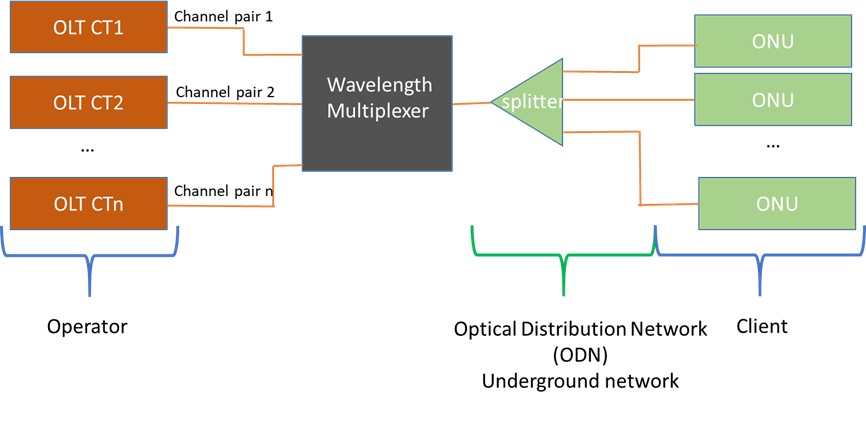
PONs are also referred to as Fibre to the Home (FTTH) or FFTX[8]. In terms of technologies, there is the time-division-multiplexed (TDM) passive optical network. This is based on point-to-multipoint passive optical power splitting that, as the name implies, provides multiple access[9]. There is also the wavelength division multiplexing (WDM) technology that is used to increase the overall bandwidth. WDM-PON has also the characteristics of point-to-point transmission, protocol transparency and others such as wide bandwidth, high capacity and network security[10]. It is also possible to combine the Time and Wavelength Division Multiplexing (TWDM). In Figure 1, we can see the architecture for TWDM case, starting with Channel Termination (CT) on the Optical Line Terminal (OLT), showing an Optical Distribution Network (ODN) and some Optical Network Units (ONU)[11].
State of Art of PONs
- PONs are already deployed at 10 Gbps[7].
- PONs with bit rates higher than 10 Gbps are currently under development and this aims to tackle the increasing bandwidth demand in access networks[12].
- 25 Gbps per wavelength and 50 Gbps per wavelength, named 25G PON and 50 GPON
- Next generation PON at 100 Gbps per wavelength is being envisioned and it is currently in active research[12].
At Instituto de Telecomunicações, Aveiro, under the POWER project, work is being done in the 50G PON field and research towards 100G PON, 400G PON and even 800G PON is targeted. To achieve such high data rates brings big challenges[12] such as bandwidth limitations and chromatic dispersion – this leads to degradation of the optical signal along the optical fibre – when using the most established detection scheme (Direct Detection)[12].
If you would like to know more about this and how the Photonic Integrated Circuits (PICs) can boost these technologies, stay tuned for the next blog post!
Blog Post Review
This blog post had the contribution of Professor António Teixeira to whom I would like to acknowledge.
 Words About Science